The Experience Past the Start
Four times in June, I posted the same idea from a different angle. A carousel about rhythm. A carousel about where activity tracking really lives. A carousel about the moment most software goes quiet. A carousel about what an experience leaves behind. Different hooks, same shape underneath. This is that shape.
Most of what I've been building has lived on Instagram and TikTok for the past few months — a scrolling feed of decks that argue, one at a time, that the software we use for real-world experiences stops too early. The blog has been quiet while that argument was being made in public. So the point of this post is simple: pull the four strongest pieces of that argument into one place and put them somewhere durable, so a reader who hasn't seen the feed can catch up in a single read.
1. Every Activity Has a Rhythm
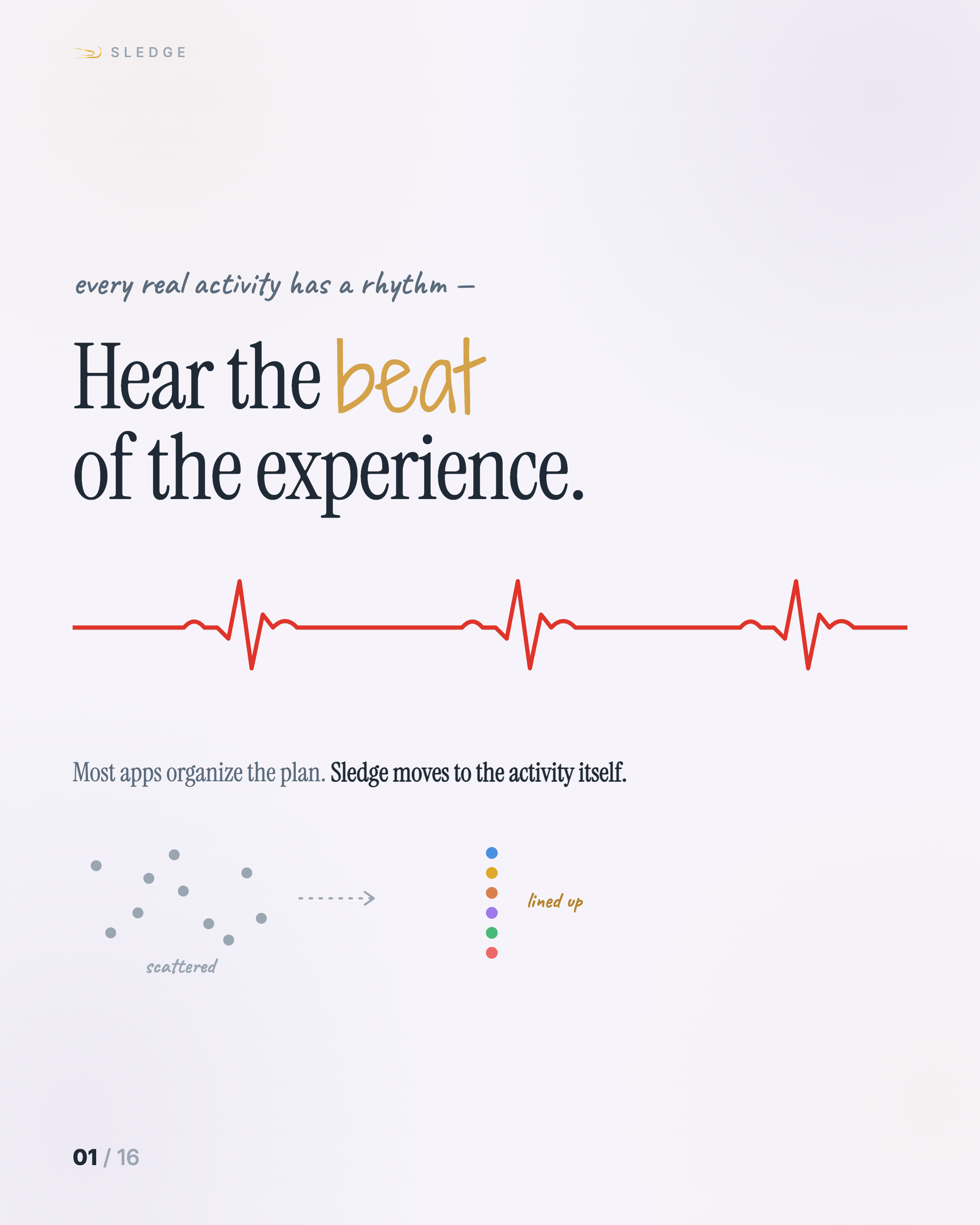
Hear the Beat — most apps organize the plan. Sledge moves to the activity itself.
View the original carousel on Instagram →
The first piece went up on June 9. The claim was that any real activity — a Sunday run, a football match, a Friday jam session, a dinner among friends — moves through four beats. There's a before: what's planned, who's coming, where it happens. There's a during: what's actually unfolding while it's live. There's an after: what got kept once it ended. And there's a next: what carries into the following one.
None of that is a new observation on its own. What's new is what happens when you name it as a rhythm and hold it up against the software people actually use to run these things. Almost every tool in this space wins one beat and loses the other three. A discovery platform wins the before. A group chat wins some of the before and a little of the during. A tracker wins some of the during. A payment splitter wins a slice of the after. And nothing at all owns the next.
The rhythm is where Sledge starts. The bet is that the tool that stays with all four beats — before, during, after, and next — is a different kind of product than any tool that wins one.
2. Where the Experience Actually Lives
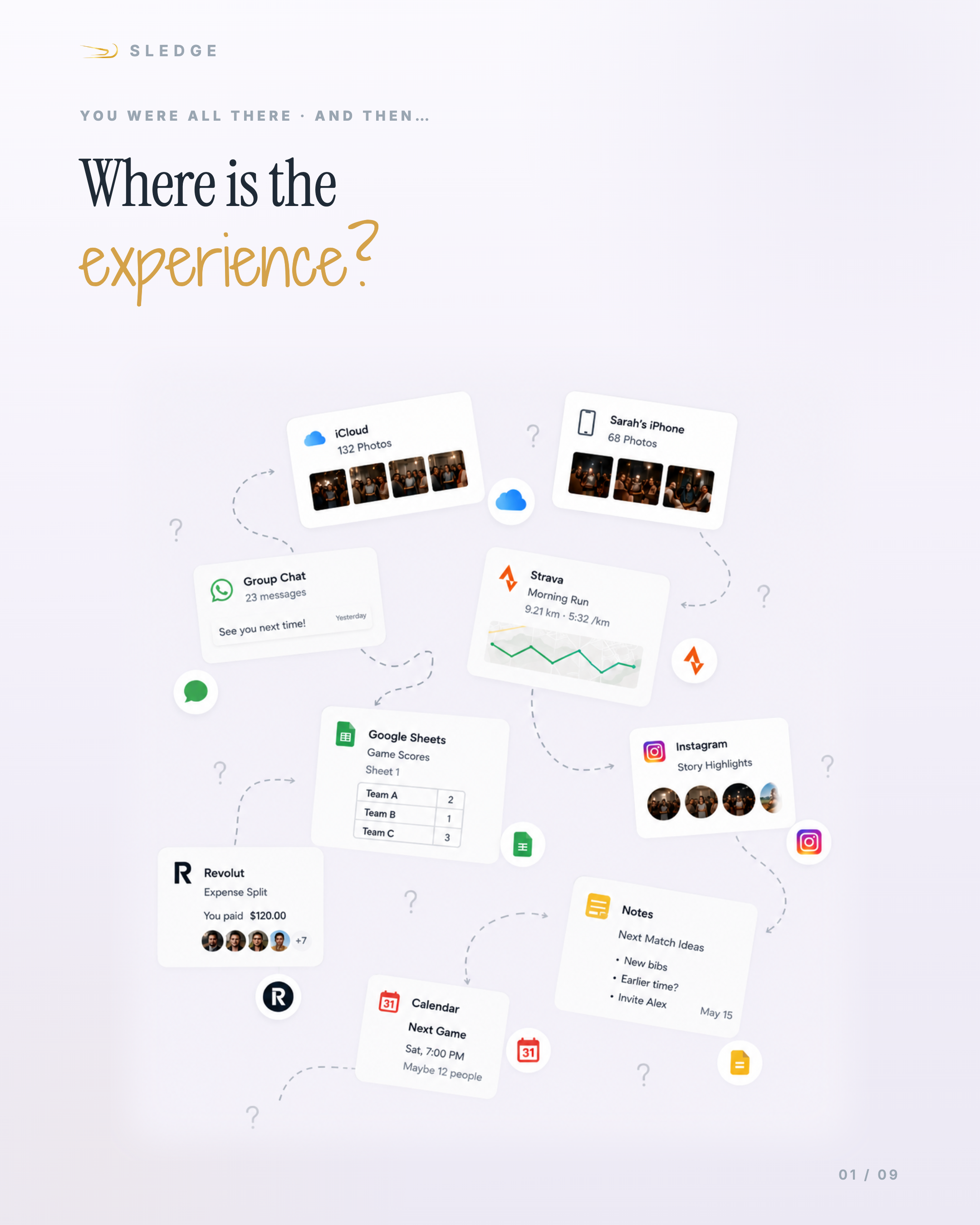
Chassis — the photos were in iCloud, the yeses in a chat thread, the run on Strava, the cost split on Revolut. The experience itself was nowhere.
The second piece, on June 14, took that same rhythm and pointed it at a specific category question: activity tracking. There's an entire industry — Strava, Garmin, Playtomic, and every step counter — that captures activity brilliantly, but captures it individually. A run is what happened to one person's watch. A tennis session is one player's serve percentage. A workout is one body's heart rate.
That's useful, but it's not the same thing as the experience. The Sunday morning run that people came back to for six weeks in a row isn't on any single person's watch. The five-a-side football game that swings on who showed up isn't on any tracker. The weekly jam night that finally landed a take worth keeping isn't in any device's memory. The activity gets logged. The experience does not.
There's a category question hiding inside that gap: where is the experience? Not the biometrics — the experience. And the honest answer, right now, is that it lives in memory, in a group chat, in whichever screenshots survived, and mostly nowhere at all. Sledge is being built to answer that question by being the place it actually lives.
3. The Booking Kept the Time. It Did Not Keep the Experience.
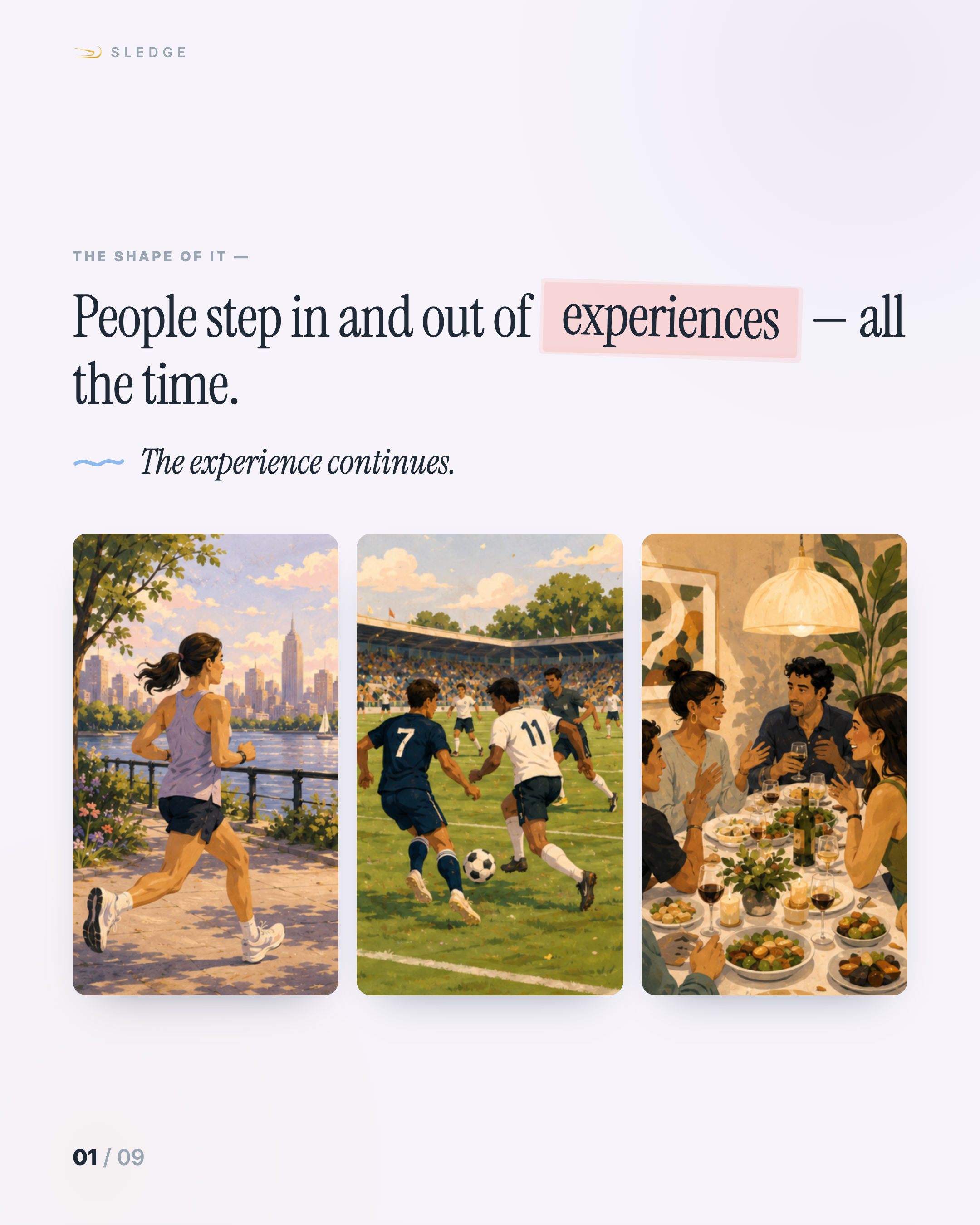
The River — three domains, one shape: the experience continues past the moment the software goes quiet.
The third piece went up on June 24 and hit the same idea harder. The setup was a line I kept coming back to: the booking page kept the time, the group thread kept the yeses, the calendar invite kept the start — but none of them kept the experience.
This is the specific way most tools fail. They capture the moment before. They do it well. They send the reminder, hold the RSVP, mark the calendar. And then, right when the thing everyone showed up for actually begins, the screen goes quiet. What actually happened during the session doesn't get recorded. Who came doesn't get remembered past the room. What was tried doesn't leave a trace. And nothing threads this week's session into next week's.
Three domains I keep using as examples in the feed, because they're structurally different from each other but structurally identical here: a Sunday run has a route, a pace, splits, and a crew who came back this week. A pickup game has a lineup, a score, an assist, and a streak that crosses weeks. A weekly jam has a set, a song, a bar, and a take worth keeping. All three run into the same wall the second the booking is done. The software that got them to the start doesn't follow them past it.
Sledge is what I'm building to follow them past it. Not another listing. Not another chat. The operating flow for the session itself — before, during, after, and next.
4. They Should Stack.
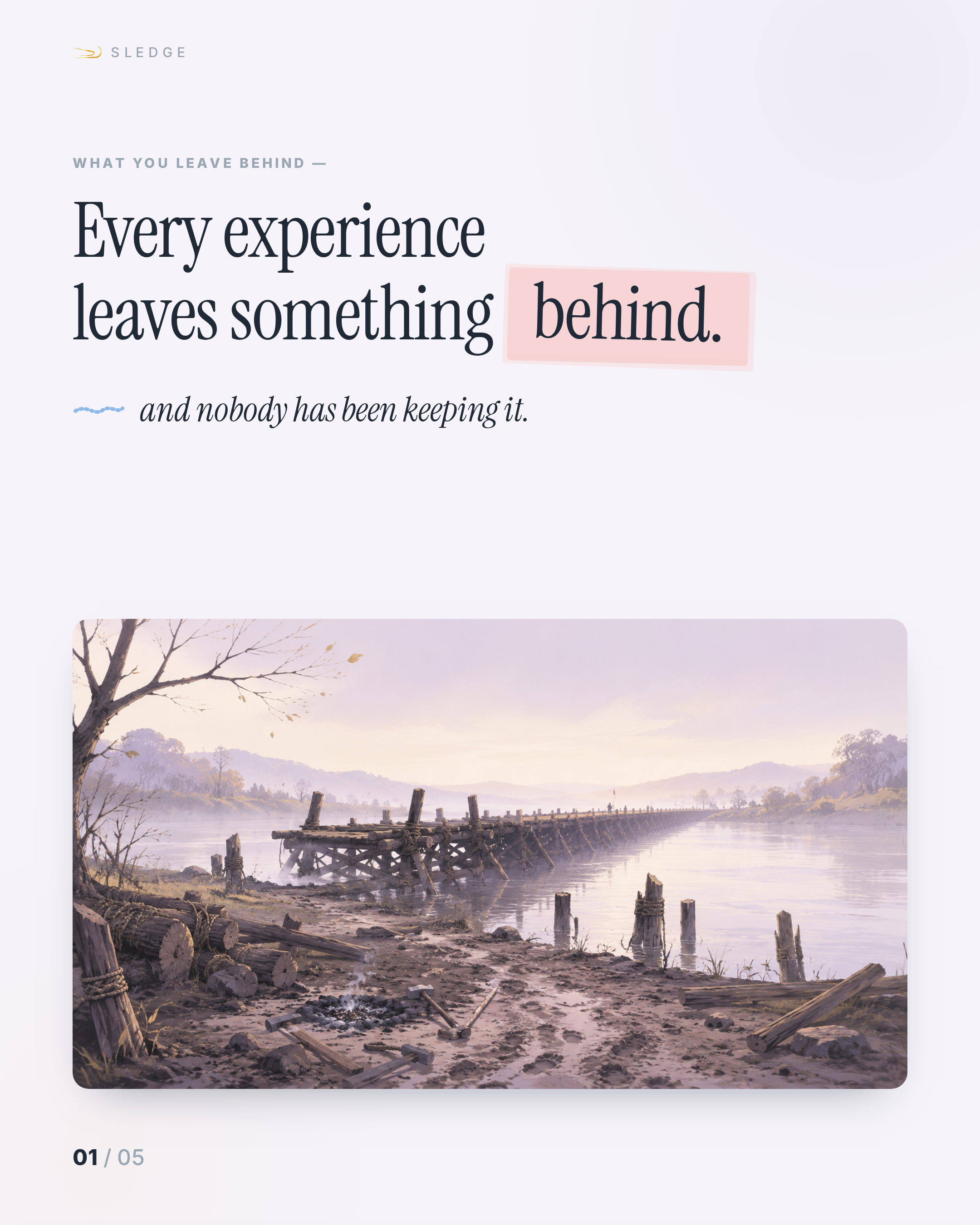
The Sunday — every experience leaves a trace. The bridge only exists because someone kept adding to it.
The fourth piece, on June 28, was the companion to the third. If the previous idea was that experiences continue past the booking, this one was that they also leave residue — and nobody has been keeping it.
Every Sunday's run leaves splits. Every pickup game leaves a streak. Every weekly jam leaves a take. Right now, nothing keeps them. So the experience starts fresh each time, even when nothing about it is actually fresh — the same people, the same route, the same setlist, week after week, arriving each Sunday like it's the first one. The proof that this is a recurring thing, the streak that crosses weeks, gets erased between sessions.
The claim I care about most from that piece is the simple one at the end: they should stack. This Sunday on top of last Sunday's. This week on top of last week's score. This jam on top of every jam before it. Not a fresh start each time. A stack. That's what a recurring experience actually is, once you strip away the tools that keep resetting it.
What This Adds Up To
Four posts, four different angles, one underlying idea. Every real-world experience has a rhythm. That rhythm has beats — before, during, after, and next — and the after and the next are the beats nobody has been holding. The result is that experiences dissolve at the seam between sessions, and every recurring thing starts over from scratch. Sledge is being built to close that seam.
Concretely, that means the product we're shipping next is not another marketplace, not another chat, and not another activity tracker. It's a session flow: an easy way to set up the session, coordinate it live, keep the record of what happened, and turn that record into the next one — one tap, same group, slightly better than last time. That's the wedge. That's what recurring sports groups need first, and it's what an interval-run group, a five-a-side crew, or a Friday jam should each recognize instantly.
We've written before about the shape of an experience after the booking is confirmed, and about experiences being the asset the whole layer is being built around. This post is the update on where the argument has moved in the past thirty days. The framing sharpened in public first, on the feed. It belongs here too now.
If any of the four beats — before, during, after, or next — is a beat you keep losing for a group you run, I'd like to hear about it. Reach me at contact@sledgeapp.com, or follow along at @buildingsledge where the next arguments are already being built.